
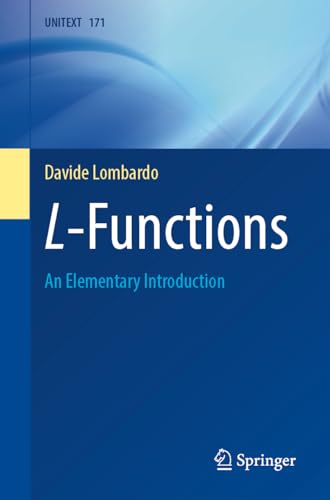
L-Functions: An Elementary Introduction/ Davide Lombardo
Series: Unitext 171Publication details: Switzerland: Springer, ©2025.Description: xiv, 261pISBN:- 9783031851445
- 512.7 LomL
| Item type | Current library | Collection | Call number | Status | Barcode | |
|---|---|---|---|---|---|---|
 Books
Books
|
Indian Institute of Technology Tirupati General Stacks | Mathematics | 512.7 LomL (12518) (Browse shelf(Opens below)) | Available | 12518 |
This book provides an accessible introduction to the theory of L-functions, emphasising their central role in number theory and their direct applications to key results. Designed to be elementary, it offers readers a clear pathway into the subject, starting from minimal background. It describes several important classes of L-functions — Riemann and Dedekind zeta functions, Dirichlet L-functions, and Hecke L-functions (for characters with finite image) — by showing how they are all special cases of the construction, due to Artin, of the L-function of a Galois representation. The analytic properties of abelian L-functions are presented in detail, including the full content of Tate's thesis, which establishes analytic continuation and functional equations via harmonic analysis. General Hecke L-functions are also discussed, using the modern perspective of idèles and adèles to connect their analytic theory with the representation-theoretic approach of Artin's L-functions. A distinguishing feature of this book is its accessibility: while largely avoiding arithmetic geometry, it provides introductions to both algebraic number theory and key aspects of representation theory. This approach ensures that the material is accessible to both beginning graduate students and advanced undergraduates. Applications play a central role throughout, highlighting how L-functions underpin significant results in number theory. The book provides complete proofs of the prime number theorem, Dirichlet's theorem on primes in arithmetic progressions, Chebotarev's density theorem, and the analytic class number formula, demonstrating the power of the theory in solving classical problems. It serves as an ideal introduction for advanced undergraduates and beginning graduate students and can also be a useful reference for preparing a course on the subject.
There are no comments on this title.